VendoIQ
From a venture studio incubation to a shipped product. Building the voice-first tool field sellers actually need, from early testing through a native build.
Role
Founding Product Designer
Type
AI-native SaaS
Field Sales
0-to-1
Timeline
Apr 2025–Present

The Problem
Field sellers lose momentum in the gap after a great conversation. Administrative busywork eats up to 70% of their time, and CRM tools built for management reporting don't help them capture what actually happened.
What I Did
Joined as founding designer inside a venture studio, taking the product from early testing through two defining decisions: a trust-first AI architecture, and a full native mobile rebuild after web pilots revealed real-world limits.
Result
Native iOS and Android apps now live for capture in the field, alongside a desktop platform for managing what gets captured. Both decisions shipped.

I joined VendoIQ as founding designer, incubated inside The Innovation Studio, with one belief guiding every decision: sales happens face-to-face, and the software should get out of the way of that, not add another screen to manage. Two decisions ended up defining the product.

Starting with early testing
The earliest UI was built for early testing, validating capture and structure before committing to a real interface.


Designing for trust
The first decision was about trust: making sure sellers could rely on what the product captured, and what eventually reached their CRM. AI was designed in as a strictly additive layer. Capture always comes first, saved the moment it happens, with AI enriching it afterward rather than deciding whether it exists at all. That same discipline shows up downstream too: before anything reaches the CRM, batch processing gives reps and teams a dedicated space to clean the data first, catching duplicates, filling gaps, resolving errors, so what lands in the CRM is trustworthy from the start.
From browser to native
The second decision was about the medium itself. A pilot at a live trade show revealed what a browser-based experience could never fully deliver in the field: reliable audio capture in a noisy room, offline-first behavior, real device-level performance. That insight led to a full native rebuild, not a UI refresh. New frontend, new backend, treated as a foundational decision on reach and reliability.
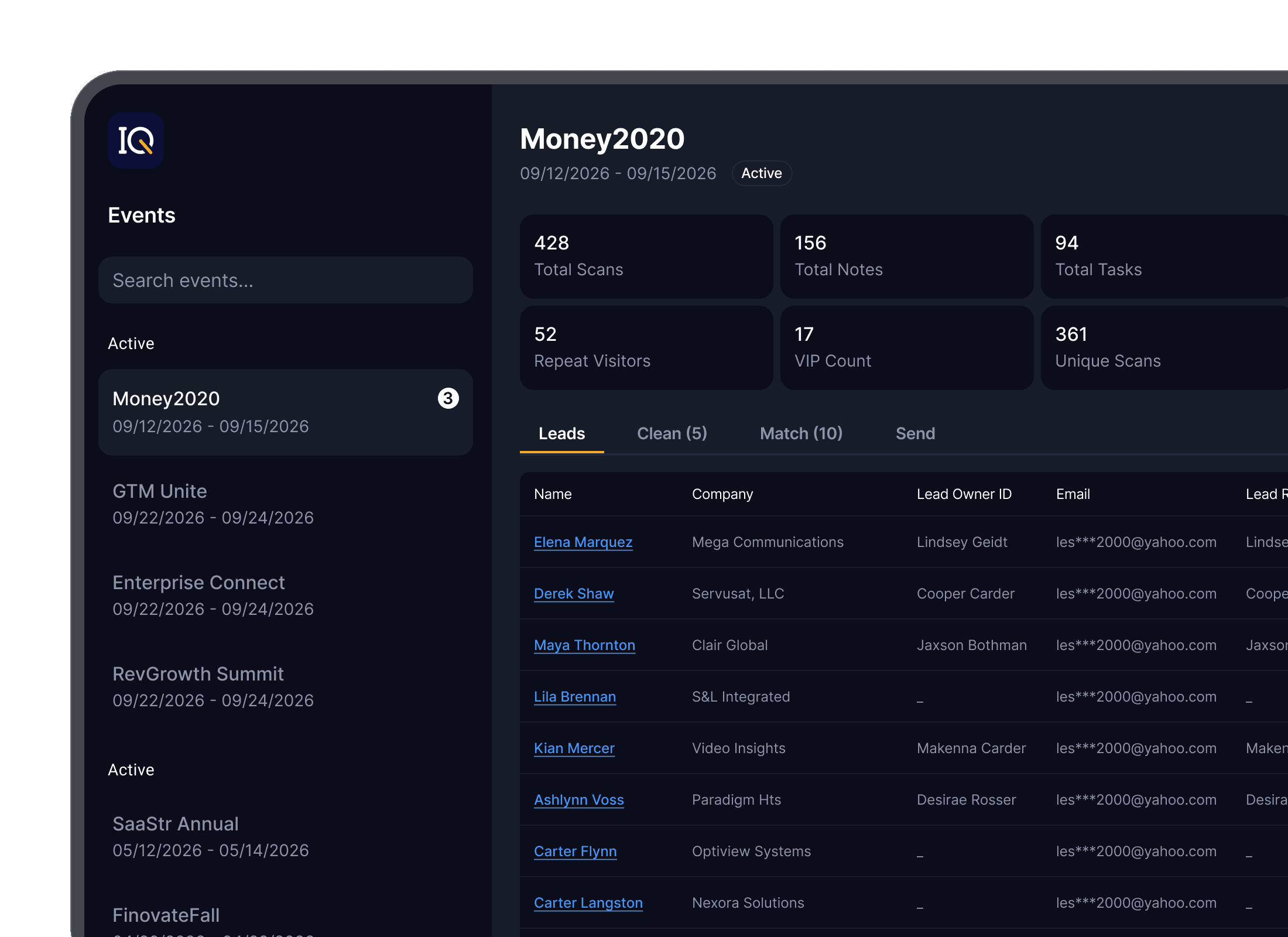
Native iOS and Android are live now for capture in the field, alongside a desktop web platform where reps and teams manage, clean, and act on everything that gets captured. The native app carries the same care through to the smaller details, tear sheets, appearance settings, filtering by conference or scan target, so the polish isn't just in the big screens, but in how the whole thing feels to use day to day.